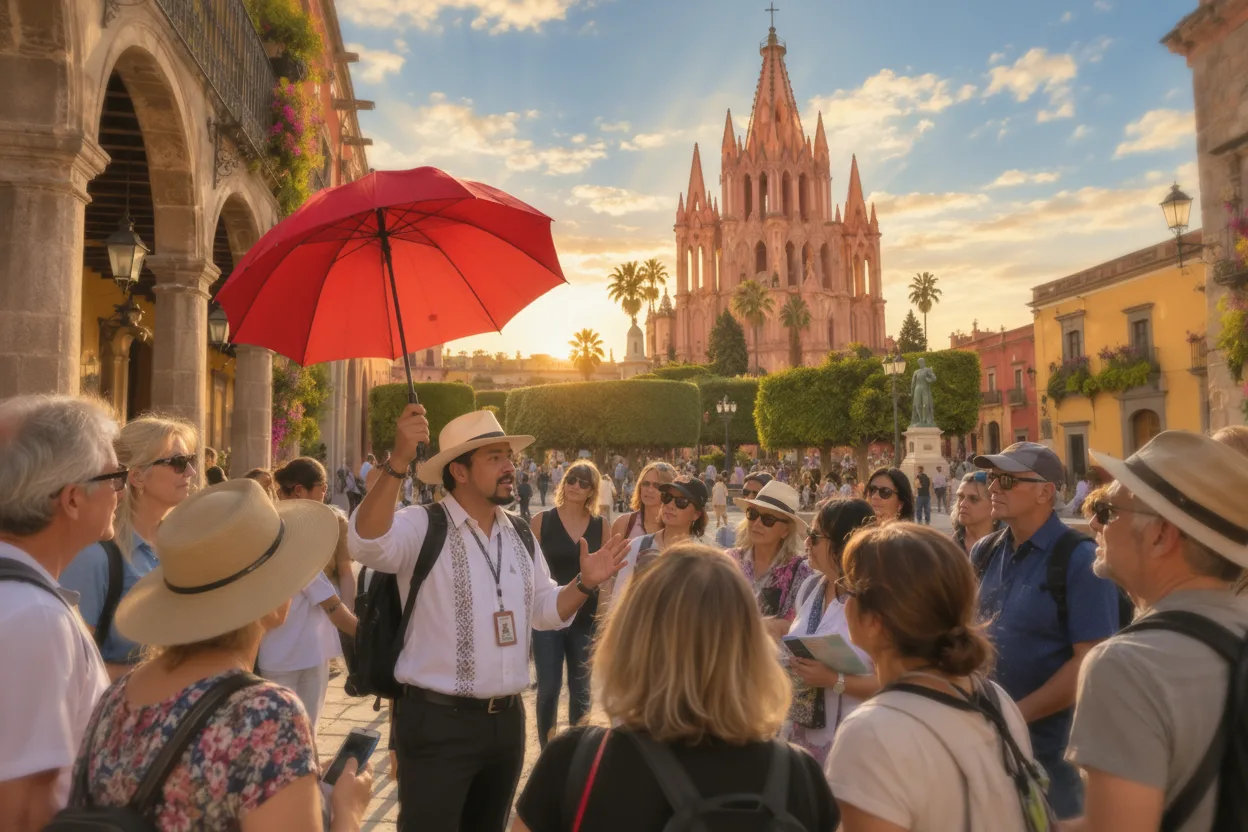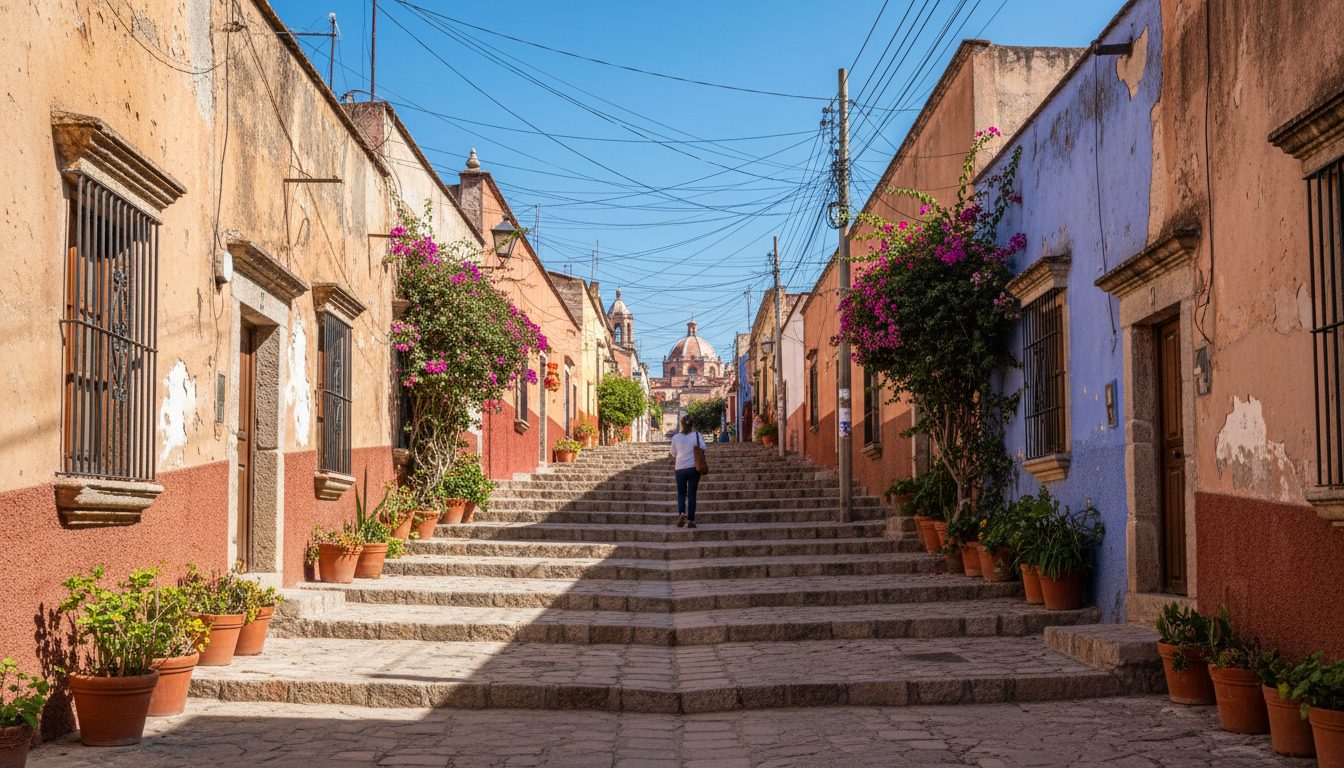
Yes. For tourists and visitors who use ordinary city sense, San Miguel de Allende is generally safe. The realistic worries are a lifted phone or a rolled ankle on the cobblestones. The context matters, though. The town sits in Guanajuato state, which carries a serious U.S. advisory, while Centro Histórico goes about its day with church bells and street vendors. When we say safe, we mean what your days actually feel like here. (Our FAQ covers the short answers; this guide goes deeper.)
Key takeaways
- Visitor-focused coverage describes San Miguel de Allende as one of Mexico’s safer destinations, with petty theft and opportunistic crime as the main concerns.
- As of September 2026, the U.S. State Department rates Guanajuato state Level 3, “Reconsider Travel,” and makes no exception for San Miguel de Allende.
- A buyer’s safety depends less on a neighborhood’s reputation than on legal safeguards: a notario público, independent title checks, and AMPI membership where applicable.
Is San Miguel de Allende safe for tourists and visitors right now?
Yes, with standard precautions, even though the U.S. State Department has Guanajuato at Level 3, “Reconsider Travel,” and makes no exception for San Miguel. The U.S. Department of State’s Mexico travel advisory is current as of September 2026. It sets Mexico overall at Level 2, “Exercise Increased Caution,” and lists crime and kidnapping among the reasons for Guanajuato’s level. The advisory mentions San Miguel only as the location of a U.S. Consular Agency. It makes no carve-out for the town or for any tourist corridor.
Third-party ratings read softer. One visitor-focused rating calls the tourist center “low risk.” Scores like that are proprietary, though, and they don’t override the official advisory.
The crimes visitor coverage flags are mostly opportunistic. Pickpockets and bag-snatchers work crowded plazas and festival crowds. Phones vanish from café tables and from hands held up for photos. Card skimmers target ATMs, so use machines inside banks, in daylight. At busy bars, keep your glass in your hand.
Daytime Centro is busy and easy to walk. Weekend evenings stay lively, but late at night the side streets empty fast. That’s your cue to stop walking and call a taxi.
Getting around:
- Taxis: just have your hotel or restaurant call one, and agree on the fare before you get in.
- Ride-hailing (Uber): availability in San Miguel has varied over time. Check the app when you arrive, leave or get around.
- Airport transfers and rural connectors: travel in daylight on toll highways. Summer rains leave potholes and wash out dirt roads.
Which neighborhoods and areas do visitors and buyers ask about most?
Centro Histórico, Guadiana, San Antonio, Atascadero and the rural outskirts come up most. Street-level conditions matter more than which one you pick. Lighting, foot traffic and how many houses are occupied tell you more than a colonia’s name does. That’s why you won’t get a “safe list” here.
Centro Histórico is busy by day and lively on weekend evenings. Its risks are theft in crowds and steep, uneven stone streets. Guadiana and San Antonio are residential neighborhoods (colonias) near Centro, so walk the route home after dark before you commit to a rental. In Atascadero, ask how you’d get to and from Centro at night, on foot and by car. The rural outskirts give you space, and with it come unlit roads, longer distances to services, and rainy-season road conditions.
In any area, check these things:
- Street lighting and sidewalks, especially on the route you’d walk at night
- Distance to services
- How many homes sit empty for months at a time
- Isolated roads and quiet ATMs you’d end up using after dark
If you’re buying, verify where each listing came from and never view a vacant home alone. Compare how different brokerages describe the same property. If one calls a street “quiet” and another says “busy corner,” ask why — the seller’s guide explains what each side must check.
Myth vs. reality: Guanajuato warnings, cartel violence, and everyday life in San Miguel de Allende
A safety myth is a shortcut that sounds true and skips what the evidence shows. Three come up constantly.
| Myth | Reality |
|---|---|
| A Level 3 advisory means San Miguel is dangerous everywhere | It is one label for a whole state — real regional risk, not a street map; no exemption for town either |
| Cartel violence routinely hits tourists and expats | Visitor coverage describes it as uncommon; theft and roads are the realistic risks |
| Online safety scores are official crime statistics | They are proprietary composites; use dated advisories and SESNSP data instead |
- Myth 1: “A Level 3 Guanajuato advisory means San Miguel is dangerous everywhere.”
A state level is one label for an entire state. It is not a street map. It isn’t meaningless either, because the State Department explicitly does not exempt San Miguel. So the fair reading is: the region carries real risk. But that doesn’t make every block dangerous. And it doesn’t exclude the town. - Myth 2: “Cartel violence routinely hits tourists and expats.”
Visitor coverage generally describes violent crime against tourists as uncommon, and most practical guides focus on theft and roads. We couldn’t find official municipal data that measures this, so we won’t put a number on it. The takeaway: theft and roads are the realistic risks, and statewide violence is the reason you don’t wander rural routes at night. - Myth 3: “Online safety scores are official crime statistics.”
They’re proprietary composites, which is why different sites can give the same town wildly different ratings. Better references are dated government advisories, Mexico’s national crime statistics from the SESNSP — the federal agency that publishes them — plus Guanajuato state public-security reports and municipal police reports. We couldn’t find current municipal crime figures we’d stand behind, so we’ve left numbers out.
What safety factors matter most when you’re considering property in San Miguel de Allende?
Property safety is mostly legal and financial, and only partly physical. A neighborhood’s reputation matters less than any of them. A property inside a gated community (a “Fraccionamiento”) gives you 24/7 security all year around. That kind of enclosure feels good.
Legal safeguards
- Notario público: the legal officer who formalizes the sale, reviews the property’s legal status and calculates the taxes due.
- Escritura: the deed. Ask to see it early.
- Independent title search: this is how you check whether the seller is the registered owner and whether liens are recorded. Ask your lawyer for a lien-free certificate (certificado de libertad de gravámenes) from the public property registry (Registro Público de la Propiedad).
- Fideicomiso: a bank-trust structure. Ask your notario whether it’s relevant to the specific parcel rather than assuming either way.
- Your own lawyer: hire one who works only for you — not for the seller or the agent. Check their professional licence (cédula profesional) in the national register. Some local brokerages can provide bilingual and expert-level legal advice.
- Your own architect: construction regulations and permits are always worth checking. Ask for a Technical Due Diligence.
These are institutional protections. An agent’s word isn’t one of them.
Agent and listing verification
- AMPI membership: shows the agent belongs to a professional association. Membership requires a state-issued realtor licence, and you can check the person in the AMPI San Miguel agent directory. It doesn’t guarantee a title or the accuracy of a listing.
- Brokerage licensing: realtors and brokerages need to have a license to work as such in the state of Guanajuato. Check the official register of licensed agents.
- Cédula profesional: verifies a professional’s credential. It says nothing about the deal itself.
- Listing aggregators: seeing every brokerage’s listings side by side helps you spot the same house at two prices or described two ways. An aggregator doesn’t vet agents, titles or transactions, so due diligence is still your job (legal, tax, technical).
Financial and physical risks
- Deposit pressure: a common red flag is a below-market home, an “owner” in a hurry, and a request to wire money to a personal account. Don’t send it. Use escrow or another structure your lawyer approves.
- Powers of attorney: a poder lets someone sign on another person’s behalf, including a fake seller’s. Have your lawyer verify any poder involved in the sale.
- Contractors: for a renovation, insist on references, a written contract and staged payments. Yes, in San Miguel it is possible to get the highest international standards.
- Vacancy: empty homes attract burglars. Arrange a caretaker, an alarm or a neighbor who keeps watch.
None of these is a reason to avoid buying. Each is a known risk with a known safeguard, and a lawyer who works for you is the one who applies them.
FAQ
Is San Miguel de Allende safe for solo female travelers?
Generally yes. Destination coverage tends to place San Miguel among Mexico’s more comfortable towns for women traveling alone, with the same caveats you’d apply in any busy tourist center. Stick to well-lit, busy routes in Centro. At night, take a taxi called by your hotel or restaurant. Keep your drink in sight, and share your location with someone you trust.
Is it safe to walk around Centro Histórico at night?
On busy weekend evenings, mostly yes. Late on a quiet weekday, it’s a different town. The real risks are uneven stone underfoot, low lighting, and phone theft while your eyes are on the screen. Wear flat shoes, use your phone’s flashlight, and call a taxi once the streets empty out.
Is tap water safe to drink in San Miguel de Allende?
Drinking it is generally not recommended. Residents rely on bottled water, big refillable garrafón jugs or home filters, and most visitors do the same. We couldn’t find current municipal guidance on whether it’s drinkable, so we’d stick to purified water. At restaurants, ask whether the ice is made from purified water. With street food and raw produce, pick busy stalls and fruit you can peel.
Is the drive from the airport to San Miguel de Allende safe?
It’s safest in daylight on toll highways (cuotas). Visitors usually fly into León/Bajío (BJX) or Querétaro (QRO), and either way you should avoid rural connectors after dark, especially during the summer rains. If you rent a car, confirm that the rental includes Mexican liability coverage. We couldn’t verify the current rules on foreign licenses, so ask the rental company, or check with your consulate before you go. Rather not drive? A pre-booked shuttle removes the question entirely.
What emergency numbers should visitors and residents know?
In an emergency, dial 911, Mexico’s national emergency line. We couldn’t confirm current direct numbers for local police, Cruz Roja (Red Cross) or tourist assistance, so ask your hotel or landlord for them when you arrive. U.S. citizens should note the location of the U.S. Consular Agency in San Miguel.
Are property viewings and deposits safe for foreign buyers?
They’re as safe as the process around them. Never view vacant homes alone. Use escrow or another payment structure your own lawyer approves, and let the notario handle formalization. Comparing a property across several brokerage listings helps you catch inconsistencies before any money moves.
Final thoughts
Adjust your precautions to where you are and what time it is. Do that, and San Miguel de Allende’s safety risks are broadly manageable. This guide reflects sources checked as of September 2026. It’s not a permanent verdict, so check the advisory again before you travel.
Once you’re comparing actual homes, market visibility is one practical tool, alongside your lawyer, your notario and your own walks around the neighborhood. It helps to see every brokerage’s listings side by side, so your picture of a neighborhood doesn’t depend on which agent you called first. San Miguel Allende Homes is a free, independent aggregator that does that. It isn’t a brokerage, and brokerages can’t pay for placement. On Wednesdays, the town’s open-house schedule is a good way to see several neighborhoods in one afternoon.
Reviewed in person by San Miguel Allende Homes before publishing. Sources checked as of September 2026; the U.S. State Department advisory and local conditions change, so re-check before you travel. This page is information, not legal or safety advice.